Friday, September 4, 2009

FEBS Letters issue on Protein Misfolding and Disease

I just learned that the 20 August 2009 issue of FEBS Letters, devoted to "Protein Folding, Misfolding and Disease," is open-access, free for download.

At the moment, I'm reading The role of molecular chaperones in human misfolding diseases [PDF] by Sarah A. Broadley and F. Ulrich Hartl of the Max Planck Institute of Biochemistry. It's a good overview of the subject, with 107 references, mostly from 2002 on.

Anxious to look at several other papers, in particular:

Bridging the gap: From protein misfolding to protein misfolding diseases
by Leila M. Luheshi, Christopher M. Dobson
http://www.febsletters.org/article/S0014-5793%2809%2900464-5/abstract?source=aemf

Structure–activity relationship of amyloid fibrils
by Samir K. Maji, Lei Wang, Jason Greenwald, Roland Riek
http://www.febsletters.org/article/S0014-5793%2809%2900528-6/abstract?source=aemf

The GroEL/GroES cis cavity as a passive anti-aggregation device
by Arthur L. Horwich, Adrian C. Apetri, Wayne A. Fenton
http://www.febsletters.org/article/S0014-5793%2809%2900510-9/abstract?source=aemf

Cells and prions: A license to replicate
by Mario Nuvolone, Adriano Aguzzi, Mathias Heikenwalder
http://www.febsletters.org/article/S0014-5793%2809%2900460-8/abstract?source=aemf

Sunday, August 30, 2009

GroEL complex in Chlamydiae

According to Karunakaran et al. (Journal of Bacteriology, March 2003, 185(6):1958-1966), the genomes of all known Chlamydia species contain three groEL-like genes (groEL1, groEL2, and groEL3). Moreover, "Phylogenetic analysis of groEL1, groEL2, and groEL3 indicates that these genes are likely to have been present in chlamydiae since the beginning of the lineage."

It is known also (Tan et al., Journal of Bacteriology, December 1996; 178(23):6983-90) that the chlamydiae have dnaK; and regulation of the dnaK and groE heat shock operons of Chlamydia trachomatis resembles that of the same operons of Bacillus subtilis and Clostridium acetobutylicum.

Thus, even the smallest of intracellular parasites comes equipped with its own robust heat-shock-protein system.

At 1.04 million base pairs in size, the genome of C. muridarum is not anywhere near as small as the genome of Mycoplasma genitalium, whose hsp system I wrote about before, but it is still pretty small. (M. genitalium has a genome of ~580K base pairs.)

The circumstantial evidence is compelling that a functioning multiple-operon hsp system is absolutely essential to all cytoplasm-producing life forms, including those that live inside other cells.

Monday, November 17, 2008

Biological Informatics Subject-Tracer Blog

Marcus P. Zillman's Biological Informatics Subject-Tracer Blog contains a long list of web resources. Some of the links are stale, but there's still a lot of good stuff there.

Friday, November 14, 2008

Amino acid "seqlets"

IBM publishes bio-dictionaries of 'seqlets' for a number of organisms. What's that? you ask. According to IBM: "In a number of publications, we have presented and discussed the idea of the Bio-Dictionary: the latter is a collection of recurrent amino acid combinations (='seqlets') which completely cover the sequence space defined by the biggest possible collection of amino acid sequences. Normally, we recompute the contents of the Bio-Dictionary on a regular basis, typically once a year."

Bio-dictionaries for a handful of Archaeal genomes and a dozen or so bacterial genomes are available for download here. Note that the files are in .Z (Unix compression format) form. Don't expect to view them in your browser.

Wednesday, November 12, 2008

IBM open-source bioinformatics tools

IBM Watson Research Center's Bioinformatics & Pattern Discovery Group has a number of interesting online tools (around a dozen in all) for which source code is available. Go to the Brief Tutorials page to get a quick idea of what the tools are all about. Some of them are rather esoteric, but by the same token that also means they're not the run-of-the-mill sequence analysis tools. These are IBM's own special contributions.

Worth checking out.

Tuesday, November 11, 2008

Journal of Proteomics & Bioinformatics

The Journal of Proteomics & Bioinformatics is an Open Access journal. All papers are available for free download in PDF format.

Saturday, January 26, 2008

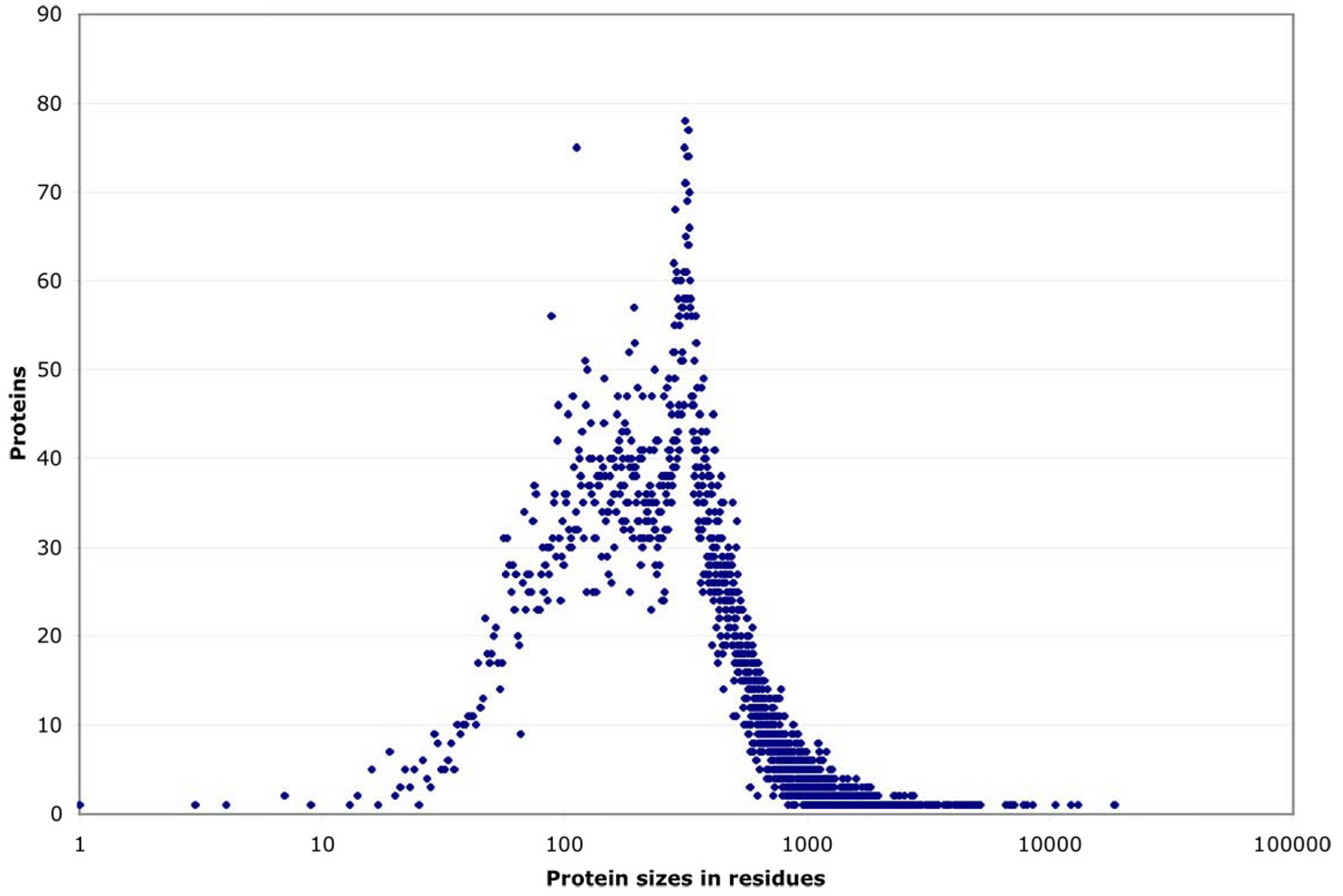
Distribution of Protein Sizes in C. elegans


Source: wormbook.org. (Click image to enlarge.)

It would be interesting to see a similar graph for E. coli (and other organisms). I suspect the spike at ~300 residues is unique to C. elegans. If you "back out" the spike, the distribution looks fairly Gaussian.

What would be interesting is to indicate certain classes of proteins in red (or some other distinguishing color), such as proteins that require special help in folding. Naïvely, one would expect larger proteins to require more assistance with folding. But it could be more complicated than that: What if proteins that require some sort of special "folding assistance" tend to clump up at particular spots in the distribution?